Bible Engagement
For several years the American Bible Society has been conducting annual research studies of what they call Bible Engagement levels in the general population. Bible Engagement is a statistical framework to map all levels of Bible involvement from lowest to highest. I won’t spend a lot of time here examining their findings other than to say over the last ten years Bible engagement has been declining to the point that most recently only 38% of adults said they engage (read or listen on audio) more than three times a year outside of a church service. Ten years ago the number was 50%. Respondents give all sorts of reasons and excuses but the bottom line is undeniable: the majority of those who would say the Bible is an important part of the life of a Christian do not really act like it. Another detail from the data is that all the while the vast majority of respondents claim that understanding the Bible is very important, very few ever try.
People like me in professional ministry view these results with profound alarm, especially when we try to come up with strategies to address it. The irony is that never in history has there been a time when more and better Bible study resources have been so readily available on such a grand scale. American Bible Society.
The problem of Bible disengagement is not actually a new one and if we used the same research tools a generation ago we might have similar results. This leads me to believe that what pollsters are tracking is symptoms of an underlying condition that has probably been the same throughout history. I believe the problem is actually three-pronged and unless each of the prongs is addressed all the good intentions and clever resources we can come up with will miss the mark.
Bible Knowledge
For years I saw the results of Bible disengagement up close and personal both as a pastor and as a professional counselor, working in a Christian, faith-based practice. What I repeatedly found was that even when clients came to me with a relatively high level of Bible knowledge it didn’t mean they had an equally high measure of Bible engagement on a day-to-day basis. I would never say that Bible knowledge is unimportant. However, I do believe that the way we define Bible knowledge itself is a significant part of the underlying problem.
When we ask kids in church, “do you know the story of Adam and Eve?” most will say they do. But what do they really know? That’s also a concern for their parents. “Know” is limited to basic information with varying degrees of detail and accuracy.
Experts sometimes talk about three different levels of knowledge. During the Reformation theologians like Luther and Calvin described the knowledge of truth that can save a sinner from hell..
Level One: Notitia (“I Notice”) factual observation of data
Level Two: Assensus (“I Assent”) meaningful interpretation and agreement
Level Three: Fiducia (“I Trust”) obedient application to life
All knowledge has to begin somewhere. Level One knowledge is not wrong in itself (unless its inaccurate). However, it is inadequate. Children especially have to learn on the simplest terms and that is why it is okay for teachers to start with Bible stories, like Adam and Eve. The problem is many never go beyond this factual observation so that as adults they are still relying on it, assuming they “know” when they only have taken the first step toward knowledge.
For purposes of this article I need to emphasize that the test of whether you know the Bible is that you have taken all three steps. How do you know if you have Level Three? It results in obedient application to your life. It changes the way you think, feel and act.
Bible Structure
Most of my Level One knowledge of the Bible came in childhood. I went to church every week and I had Bible story books at home. I am so thankful I had this kind of foundation. However, it wa not enough to fully know the Bible let alone know God. One particularly consequence was that until many years later my understanding of one particular story—like Adam and Eve in the Garden of Eden–had very little connection to other parts of the Bible.
A good example is putting together a jigsaw puzzle. Whether it’s a 100 or 1000 piece puzzle, the box always contains individual puzzle pieces, distinguished by their shape (structure). Imagine all those pieces scattered on the table as Level One Knowledge and, when you start looking for shapes and structures that fit perfectly together that is like Level Two Knowledge.
This is how we make sense of the Bible; how we interpret its meaning. We have to look for structures and patterns, not just in one passage of Scripture but in others that fit with it. I’m simply trying to explain why Bible structures and patterns are essential to have Level Two Knowledge and showing why so few people do all the work necessary to acquire it.
But it is precisely at this point we find one of our greatest hurdles to Bible engagement. In short, our capacity to fit all the pieces together is limited because as modern (post-englightenment) readers we view the very stories and events themselves differently from the ancients. The. Bible scholar and writer of many controversial books on ancient biblical worldview, Michael Heiser, said it like this:
“I’ve taught the Bible in churches and seminaries for over twenty years. The number one reason people give for not reading the Bible is that they don’t understand it. The number one reason they don’t understand it is that no one has ever shown them the supernatural worldview that permeates every page.” (Heiser, lecture “Reversing Hermon” Q&A, 2017; transcribed in Reversing Hermon, Appendix I)
It may take some deliberation to appreciate what Heiser is saying here, especially if you don’t understand the term “supernatural worldview.” But without a profound sense of the reality of the supernatural realm, we can never put the jigsaw together. The best we will get is what I call Level One knowledge and, particularly as adults, that knowledge will never be enough to sustain our own Bible engagement.
I have researched learning theories and teaching methods for decades and have very strong convictions about how they work, especially in Bible knowledge. I can say without hesitation that pattern recognition and structural frameworks are the missing “piece” for most people in Bible knowledge. This is what stories really are. An individual bit of information about Adam and Eve is not a story, it’s just a data point. Combine several details, however, and you begin to find the story. The more you add to those, the more we understand the larger story God is telling. In terms of worldview, this means we must work extra hard to see the connection between the people and events on earth and the mysterious “rest of the story” taking place behind the curtain in the unseen realm.
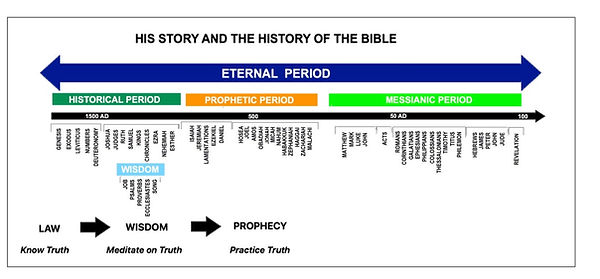
I titled this study His Story: God’s Story of History to reflect that idea. An essential part of His Story is the structural framework in which the grand story line is revealed. I won’t hide what that structural framework is. The more clearly you recognize the structure the more capable you are of fitting all the individual puzzle pieces together. Theologians call it ‘covenantal structure.” The covenant framework is a worldview in which natural history is essentially connected to supernatural. An example most are familiar with is the Book of Job, especially the first three chapters. I won’t tell that story here but it is important and will be a focus later in His Story.
I won’t explain the details of ancient covenant structure in this article. I’ve done so in many other articles in my library (see my Introduction to Covenant Theology).
But here I will say that when God revealed his grand story of history in the Bible, each detail and person and event in the Scriptures–from Genesis through Revelation–reflected the ancient covenant structure. That covenant structure meant that beyond the horizon of our mortal sight lay a vast, eternal realm in which the covenant God, attended by a mysterious council of spirit beings, was both observing and directing every detail in history. As a covenant, this worldview also demonstrates how the one realm can only be understood in the context of the other. I believe covenant structure is like a secret key unlocking all the verses of the Bible, not just what they mean (Level Two Knowledge) but, most importantly, how they can change our lives (Level Three).
It is no coincidence that in the Bible “knowledge” is a covenant term describing more than information. Thus, when Adam was said to “know” his wife and in that act have a child, clearly knowledge is not just information but relationship—the most deep relationship between a husband and wife.This is also the goal of Bible engagement itself, not just Level One or even Level Two, but Level Three: not just noticing or agreeing with the Bible but trusting it.