
Till By Death We Do Part: An Introduction to Covenant Theology by J.E. Rose
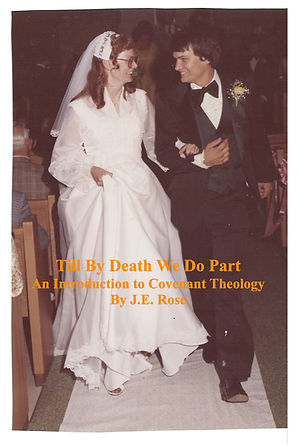
My wife Cindy and I (pictured above) married in 1980, writing our own vows that reflected the sacred gravity of a covenant relationship, intended to last forever, unlike temporary contracts. Today, we often confuse covenants with contracts, leading to a misunderstanding of marriage as a temporary business arrangement rather than an ongoing personal relationship. The Bible, however, is replete with covenant language, from the terms "Old and New Testaments" to the concept of covenant relationships appearing on nearly every page. A functional understanding of covenants is crucial for comprehending the Bible and theology. I have more than a dozen books on covenant theology in my own library and sores more have been written. I don't intend to do more in this introduction than answer seven crucial questions I hope will inspire you to expand your own appreciation of this all important biblical truth.
What is a Covenant?
In Hebrew, "b'rit" (covenant) meant "to cut," referencing ancient rituals where animals were cut in two, symbolizing the permanence of the agreement. The Greek "diatheke" also meant "will" or "testament," emphasizing the legally binding nature. Theologians like O Palmer Robertson defined covenant as "a bond in blood sovereignly administered," signifying a solemn, life-and-death commitment ordained by God. While some covenants involved blood sacrifices, others, like the covenant with David, did not. Therefore, Robertson’s definition was true but lacking in broader application. The take away for us here is the distinction of the purpose of covenants and contracts. Covenants aim to establish ongoing personal relationships. This is why God used them to create personal relationships with humanity.
How Were Covenants Structured in the Ancient World?
This “covenant awareness” diminished after the Roman era and was gradually replaced by what i call a contractual worldview. It would be 1500 years before scholars rediscovered the importance. This occurred in the early 20th century by scholars like George Mendenhall who studied ancient Hittite covenant documents and their widespread use of a five or sixfold structure. Mendenhall found a similar structure in the story of the law covenant given to Moses on Mount Sinai. He published his findings in Law and Covenant in Ancient Israel (1955). Around the same time, Meredith Kline a seminary professor, applied that structural awareness to a study of the Book of Deuteronomy. It was called, Treaty of the Great King: The Covenant Structure of Deuteronomy: Studies and Commentary (1963). Though there are variations, the general finding was that ancient covenants contained a five-part structure:
-
The Preamble: Introduces the parties, usually a transcendent king and his subjects.
-
The Historical Prologue: Recounts the sovereign's history, focusing on mediators.
-
The Requirements: Legally binding obligations, like the Ten Commandments.
-
The Sanctions: Rewards for obedience and judgments for disobedience.
-
The Continuity: Explains how the perpetual and renewable covenant would endure across generations.
I am persuaded that this fivefold structure is more than an ancient legal format but more profoundly reflects the eternal relations of the triune God himself.
Why Were Covenants Necessary for Relationships?
In the ancient world's hierarchical structure, kings and nobility were seen as distinct from commoners. Theologically, "transcendence" highlights God's infinite difference from his creatures. Covenants are necessary for such a transcendent king to have a personal relationship with his subjects. God reveals himself through special revelation (the Bible), natural revelation (creation), and "living" revelation (Jesus Christ), all reflecting covenantal condescension to enable a relationship between God and humanity.
What Are the Divine Covenants?
Theological reflection has identified specific divine covenants, though not all terms are explicitly in the Bible:
-
Covenant of Redemption: A prehistoric agreement between the Father, Son, and Holy Spirit for the plan of redemption (Ephesians 1:3-14).
-
Covenant of Creation (also called "Works"): God's covenant with Adam at his creation including creation mandates and prohibition of the tree. It requiredperfect obedience (Malachi 2:5). Adam's disobedience led to the next covenant.
-
Covenant of Grace: God's plan for salvation, progressively unfolded through five administrations:
-
To Adam: Grace extended through blood sacrifice for sin (Genesis 3:30-31).
-
To Noah: Human government and the sanctity of life (Genesis 9).
-
To Abraham: Father of nations and promise of an eternal dwelling (Genesis 12).
-
To Moses: The gift of the law at Mount Sinai (Exodus 20).
-
To David: An everlasting throne and dynasty pointing to Jesus Christ.
-
These administrations are all part of the singular Covenant of Grace, with one way of salvation. The "second Adam," Jesus, perfectly fulfilled the Covenant of Works, uniting believers in the eternal promises of redemption.
Why is Covenant Theology Necessary to Accurately Understand the Bible?
Covenant theology, also called "biblical theology," provides a framework to understand individual Bible stories as part of "His Story" – God's overarching plan of redemption. It helps to see the connections between the Covenant of Grace administrations and their fulfillment in the "Messianic Period" through Jesus.
How Do the Covenants Relate to Each Other in History and Eternity?
The Covenant of Redemption is appreciated against the backdrop of God's eternal "glory" (John 17:3). Before creation, the Father, Son, and Spirit existed in consummate glory. This "Eternal Covenant of Glory" grounds covenant structure, and faithfulness to covenantal relationships allows us to enter into that glory.
Does Covenant Theology Apply to Our Daily Lives?
Covenant theology offers practical applications for daily life, especially during life's storms. As a professional counselor, I've found that the ancient covenant structure reflects God's eternal design for peace. This is outlined in counseling materials like "Steps to Peace in the Storms of Life," which applies covenant sections to personal struggles:
-
Preamble: Remembering God in the Storms of Delusion.
-
Historical Prologue: Revealing Heart Desires in the Storms of Disorder.
-
Requirements: Renewing Beliefs in the Storms of Distortion.
-
Sanctions: Restoring Strength Habits in the Storms of Distress.
-
Continuity: Rebuilding Relationships in the Storms of Dysfunction.
Finally, the concept of "Shabbat Shalom" (peaceful sabbath) connects to covenant theology through the promise of a Sabbath rest for God's people (Hebrews 4:9-10). This rest, our eternal destiny, is also experienced in foretastes in this life when we apply covenant truths amidst our challenges.
Though the covenant promise my wife and I made was "till by death we do part", that limitation is in recognition of our own human mortality and the finite nature of creatures like us. When God establishes a covenant with his creatures it is not subject to the same restriction. As the final words of the New Testament promise,
He showed me a river of water of life, clear as crystal, proceeding out of the throne of God and of the Lamb, in the middle of its street. On this side of the river and on that was the tree of life, bearing twelve kinds of fruits, yielding its fruit every month. The leaves of the tree were for the healing of the nations. There will be no curse any more. The throne of God and of the Lamb will be in it, and his servants will serve him. They will see his face, and his name will be on their foreheads. There will be no night, and they need no lamp light or sun light; for the Lord God will illuminate them. They will reign forever and ever (Revelation 22:1-5).